Homelessness in Florida
The Shimberg Center tracks homelessness using HUD's Annual Homeless Assessment Report and student data from the Florida Department of Education's McKinney-Vento program. Estimates of homeless individuals and families are available in the Florida Housing Data Clearinghouse and Statewide Rental Market Study.
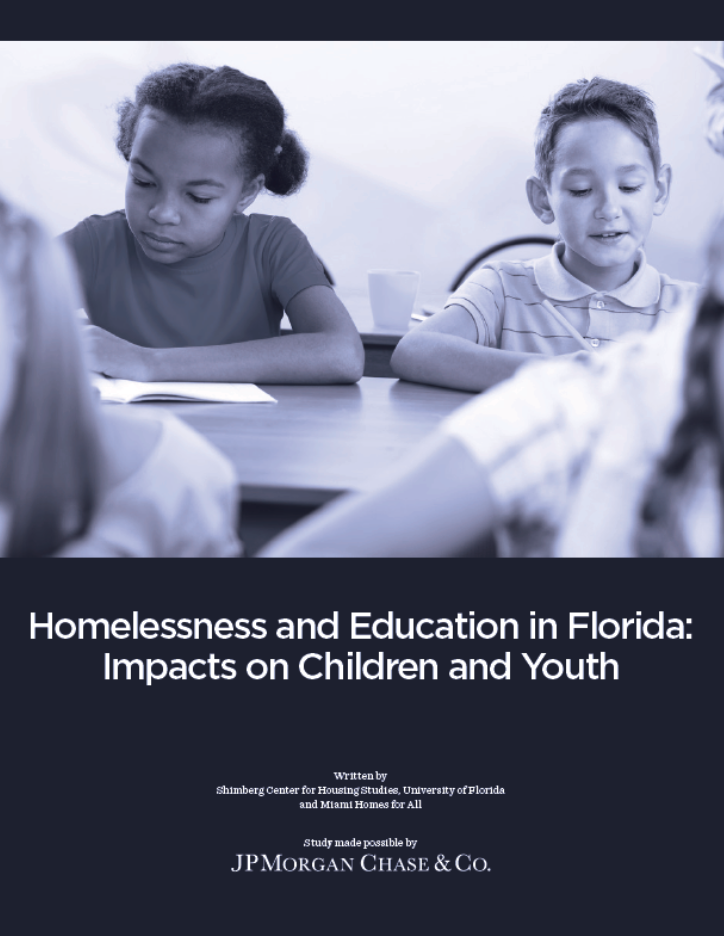
In 2017, the Center and Miami Homes for All released Homelessness and Education in Florida: Impacts on Children and Youth, with support from JPMorgan Chase & Co. The report showed that homeless students were more likely to miss school, less likely to pass state English, math, and science tests, and more likely to face disciplinary action than their housed peers. It also documented the wide array of enrollment, transportation, in-school, and referral services provided by Florida school districts to homeless students.
The Center continues to provide data on test score gaps between homeless and housed students in the Clearinghouse. We also provide a map of student homelessness by school.
To assist older adults, the Center provides data to support the Elder Housing Initiative of the Florida Supportive Housing Coalition. The initiative promotes housing and service solutions for Floridians age 55 or older at risk of losing their homes.
Key findings
- An estimated 29,848 individuals and 44,234 families with children were homeless in Florida in 2024. This includes individuals and families in shelters, unsheltered locations, hotels and motels, and doubled up with others.
- 97,762 students were identified as homeless in 2023-2024, the first time in recent years that levels were this high without major student displacement by a hurricane. Most of those students (74,602) were doubled up with others.
- Just over 1/3 of homeless students passed Florida's English, math, and science tests in 2024-2025, compared to half of low-income, housed students and 2/3 of other housed students.
- 8,947 people age 55 or older were identified as homeless in the 2024 Point-in-Time count in Florida.